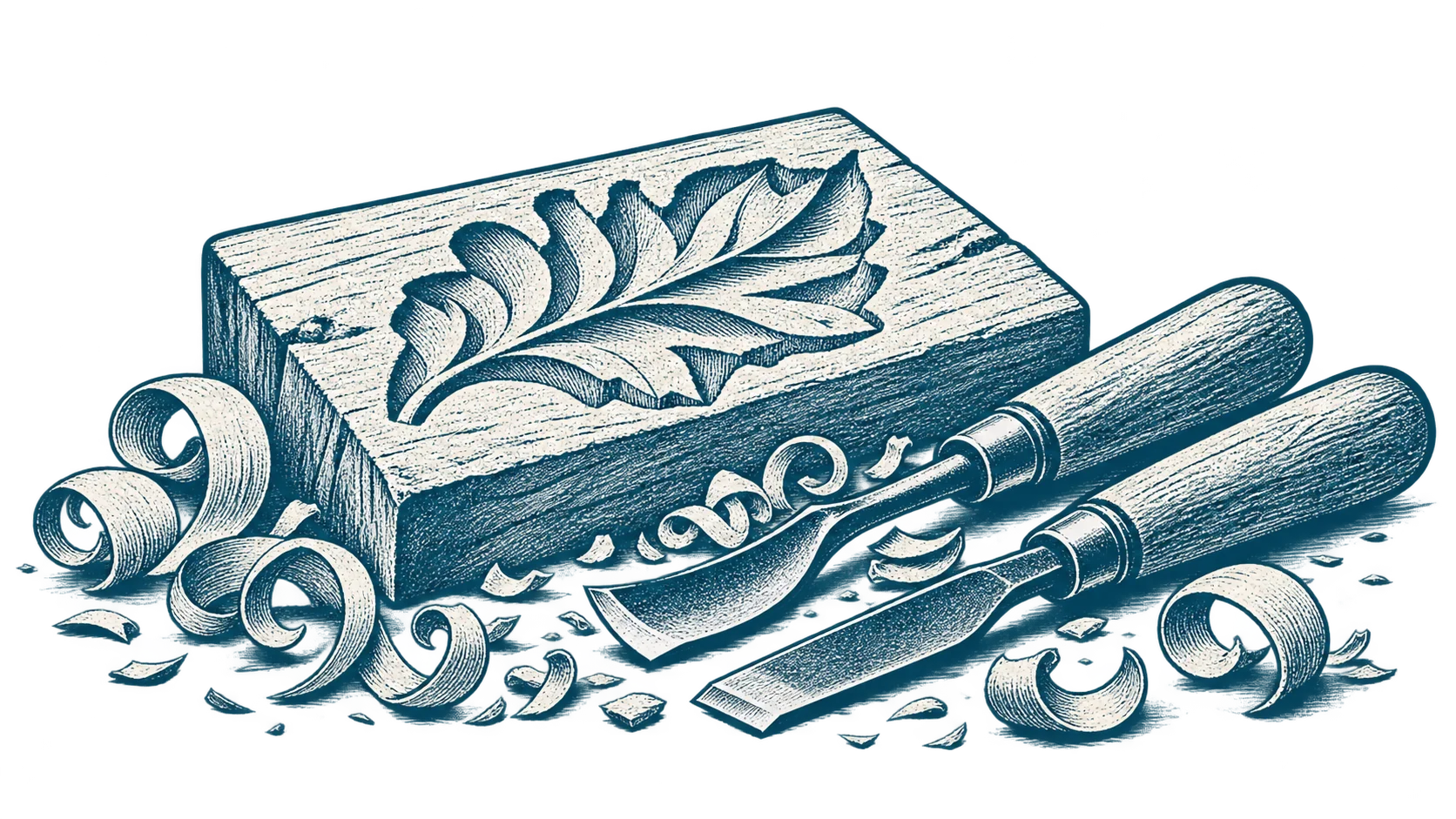
Woodcarving
Someone gave me an old Edwardian front gate. It was made of teak and was completely free of rot. They asked if I could make a table out of it. I’m always up for a challenge, so I made a table out of a gate.
It still looks a bit like a gate. It has the original house name carved into it and even a little enamelled house number attached. It’s now our outdoor coffee table.
I enjoyed working with the teak. When I sawed through the grey, weathered surface, I discovered the beautiful colour of the wood beneath. I had a few offcuts, so I thought I’d try carving something. I’d never carved before and didn’t own any chisels, so I used a sharp knife. I made a little pot. I rather liked it.
Woodcarving chisels followed, and so did more ambitious projects. Every piece I carved came from wood I’d been given or from trees in the garden.
My biggest sculpture was carved from a tree trunk. Admittedly, a small tree, but a tree nevertheless. It was a Ligustrum, or privet, which here in South Africa is considered an invasive species. The wood, however, is lovely to carve and has a beautiful pale colour.
I made a frame to support the trunk while I worked and started carving with absolutely no idea what it was going to become. Eventually, it turned into something I rather pretentiously called Horned Helix.
I think what I love about carving is that you have to imagine what you’re making and somehow see the shape hidden inside the wood. Gradually, it reveals itself, which to me is quite magical. Perhaps it requires a part of the brain we don’t normally use. You have to see a three-dimensional image inside a solid block of wood. It focuses your attention and absorbs you like almost nothing else.
When I look at pieces I carved years ago, I’m immediately transported back to the time I was making them. I remember the day, where I was, and sometimes even what I was thinking. It’s extraordinary how much of a memory can become attached to an object you’ve made with your hands.
I don’t think I could ever sell one of my carvings. They feel too much a part of me.
Woodcarving does have its disadvantages. Chisels need constant sharpening, and sharp chisels have an unfortunate habit of cutting hands and fingers. They also occasionally remove rather more wood than intended. Most of my carvings started out considerably bigger in my imagination than they eventually became.
It’s hard work, too, and I suspect that’s one reason pottery began to seem rather more appealing.
But I haven’t abandoned carving. If an interesting piece of wood comes my way, I’ll happily get the chisels out again and see what might be hiding inside it.